Showing posts with label Animation. Show all posts

Friday, November 29, 2024

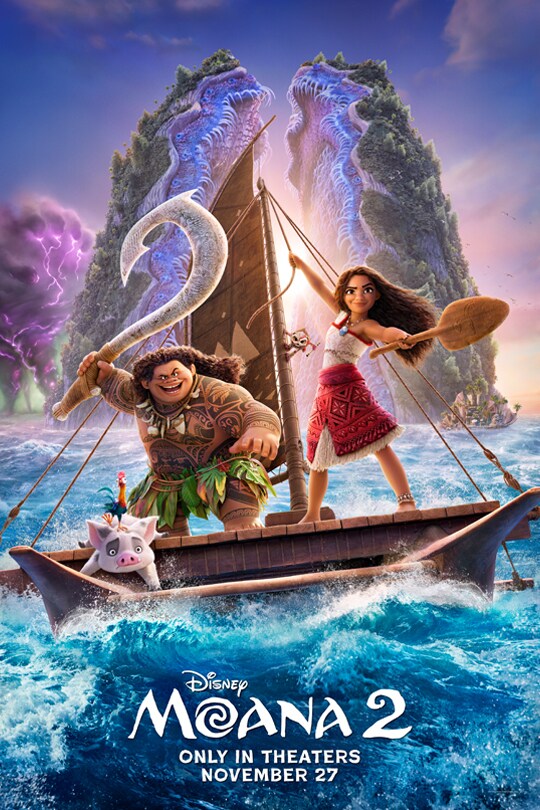
Review: 'Moana 2' barely wayfound box office success


© Disney

For being a sequel to one of Disney’s most successful movies, “Moana 2,” known as “Vaiana 2” and “Oceania 2” in some markets outside the U.S., narrowly excels at being an impactful continuation of the original 2016 movie. 

“Moana 2” debuted in U.S. theaters on Nov. 27 and it ceremoniously followed the main character, Moana, and her village, Motunui, three years after “Moana” (2016). In the 2016 movie, Moana, the village chief’s daughter and an aspiring wayfinder, voyaged with her hog Pua, her chicken Heihei and Maui, a comedically mighty demigod, across the treacherous ocean to find and restore Te Fiti, a once-vibrant island that became a calamitous and desolate demon after Maui stole its heart a millennium ago. Together, Moana and Maui underwent massive character development and successfully restored Te Fiti.

“Moana 2” tweaks some of the first movie’s plot, adding noticeably higher stakes. 


This time around, Moana, after receiving a vision from her ancestor Tautai Vasa, must find the island of Motufetu, a revered central hub for all of the islands until Nalo, a human-hating god, cursed it and sank it to the bottom of the ocean to destroy humanity and establish his dominance. If Moana fails to save Motufetu, humanity will fail to reconnect with each other and cease to exist.

Given these stakes, Moana is aided not only by Pua, Heihei and Maui, but by a trio of new characters from her village: Loto, a skilled craftswoman; Moni, a strong farm boy who idolizes Maui and Keke, a grumpy, old man who adept at farming.


This simple and arguably repetitive plot retcons elements of the original movie, such as the Motunui’s reason for being separated from society, but it does expand the scenic world of “Moana” while also setting up electrifying action sequences that cemented Moana’s place as one of Disney’s best princesses.

However, despite its success in the action department, many things leading up to the action are incredibly lackluster. Outside some one-off moments of teamwork, our new heroes failed to be memorable like other helpers in other iconic Disney princess movies, such as Mushu from “Mulan” (1998), Ray from “The Princess and the Frog” (2009), or Flounder and Sebastian from “The Little Mermaid” (1989).

This issue and others, unfortunately, likely stem from executive decisions made within production.

For example, Maui’s pivotal role in helping Moana save Motufetu was delayed for a sizable amount of the movie because he was held captive by Nalo’s female accomplice, Matangi ,until she secretly betrays him and helps our heroes.


This delay would make sense in a TV show format since tension would build over episodes, and apparently, “Moana 2” was initially meant to be just that, a TV show, but since it isn’t Maui’s delay in the 1 hour and 40-minute slot feels untimely and unsatisfying given his character’s charm and importance.


Another issue likely caused by production changes is Nalo’s presence. Despite repeatedly being mentioned as a harrowing evil, Nalo never reveals himself physically. He attacks our heroes with lightning storms and sea monsters, but he remains unseen in physical form until a post-credits cutscene where he forces Matangi to serve him in his revenge after Motufetu is restored by our heroes.

Lastly, the absence of Lin-Manuel Miranda, a heavy contributor to the original movie’s music, was heavily felt. Despite having spirit, great animation and timely placements, “Moana 2’s” songs, produced by new songwriters Abigail Barlow and Emily Bear, lacked catchiness due to clunky lyrics. Neither I nor my “Moana” stan teenage cousin recalled any song lyrics when we left the theater.

Thankfully, despite its pitfalls, “Moana 2” will be remembered for its action and the development of Moana and Maui as both characters literally died and came back to life to save Motufetu.  The post-credit scene with Nalo and Matangi guarantees another continuation of the story.

What Disney must do now between now and then is ensure that “Moana” doesn’t deteriorate into a failed sequel cash grab franchise or endure the same pitfalls in pacing or music.

But for now, given what “Moana 2” has offered, I give it a 7: barely passing. 


I’m cautiously optimistic about what will happen next.

Review: 'Dragon Ball DAIMA' revives 'Dragon Ball''s adventure roots


Created by: Akira Toriyama/ ©BIRD STUDIO/SHUEISHA, TOEI ANIMATION

 Before mangaka Akira Toriyama died last March, he finished writing “Dragon Ball DAIMA,” a continuation series of his 40-year, legacy-defining shonen, “Dragon Ball.”

To say that what Toriyama envisioned and produced with “DAIMA” exceeded my expectations would be an understatement.


“Dragon Ball DAIMA’s” first episode debuted in Japan on Oct. 11, 2024. Hulu and the anime studio and streaming service Crunchyroll aired the series’ first episode with English subtitling of the Japanese audio internationally just hours later. Netflix USA would follow suit, airing the series’ first episode with English subtitles on Oct. 18, and shortly thereafter, a limited release of the series’ first three episodes with an English dubbing produced by Crunchyroll aired in U.S. theaters between Nov. 10 and Nov. 12.


“Daima” is a term Toriyama made up. From Japanese, “Daima” roughly translates in English to the word, “evil,” but when kanji text is used for the term, it translates to “great” and “demon/magic.”

In “Dragon Ball DAIMA,” Toriyama masterfully combines the retro adventure themes of “Dragon Ball’s” story in the mid to late ‘80s with the franchise’s current action themes that have cemented its place in pop culture since the early ‘90s.


Within its first eight episodes, the series expands the world of “Dragon Ball” flavorfully by reintroducing old concepts with new places and characters, namely the Demon Realm.

In episode one, a freshly animated recap of  “Dragon Ball Z” —  the famed series prequeling “DAIMA” in the franchise’s current canon — briefly informs viewers of the origins of “Dragon Ball’s” protagonists fighting evil ahead of  “DAIMA’s” plot.

After the recap, antagonist Demon King Gomah, from his lair in one of the three worlds of the Demon Realm, heads to Earth in search of the Dragon Balls, a set of seven sequentially-starred orbs that summon a magical dragon who can grant two powerful, but limitation-bound wishes. 


Gomah intends to neutralize our protagonists: Son Goku, the Z Warriors and their allies.

With the help of his mystical accomplices, Degesu and Neva, Gomah gathers all seven Dragon Balls and makes a wish to turn all the series’ protagonists into children. Despite not being aware of what’s happening, the memories and powers of our protagonists aren’t erased due to the wish being short-sighted. 


In episode two, after making this wish, Gomah and crew kidnap the Earth Dragon Balls’ overseer, Dende and flee the planet to return to the Demon Realm to prevent our protagonists from using the Dragon Balls to reverse the wish.

At the same time, Glorio, another new character from the Demon Realm, arrives on Earth with a plane that can travel through realms. He informs our protagonists of their predicament and offers to help. Goku and his ally, the Supreme Kai, agree to travel with Glorio into the Demon Realm to find and defeat Gomah’s forces and to reverse his wish on their bodies.


Between episode three and the current episode, episode eight, the adventures Goku and Shin have with Glorio within the Demon Realm, albeit slow-paced, are entertaining.


From humorous dialogue and interactions that sent my friends and me hollering with laughter into text chats, to crisp fights and animation reminiscent of  “Dragon Ball” video games and practical introductions and connections for new characters and the Demon Realm, “DAIMA” fares better in adventure than other “Dragon Ball” media, such as “Dragon Ball GT,” a series that had Goku, his granddaughter and another protagonist venture in space to reverse a gag villain gang’s wish that turned him into a child.

Even though “Dragon Ball DAIMA” will never compare to “Dragon Ball Z,” the continuation series “Dragon Ball Super,” or even some of  “Dragon Ball GT” due to their acclaimed action elements and long-term impacts on the franchise, “DAIMA” brings its own unique contribution to
the world of “Dragon Ball.”


Despite all the concerns surrounding its early production, as the show’s theme song, “Jaka Jaan,” suggests, it really is a “DAIMA wonderland” worth watching.

The series will last at least 20 episodes with weekly releases going through early 2025 in Japan and on streaming services. The English dub does not have a finalized release schedule yet, but it will likely be added onto Crunchyroll, Hulu and Netflix during 2025.